

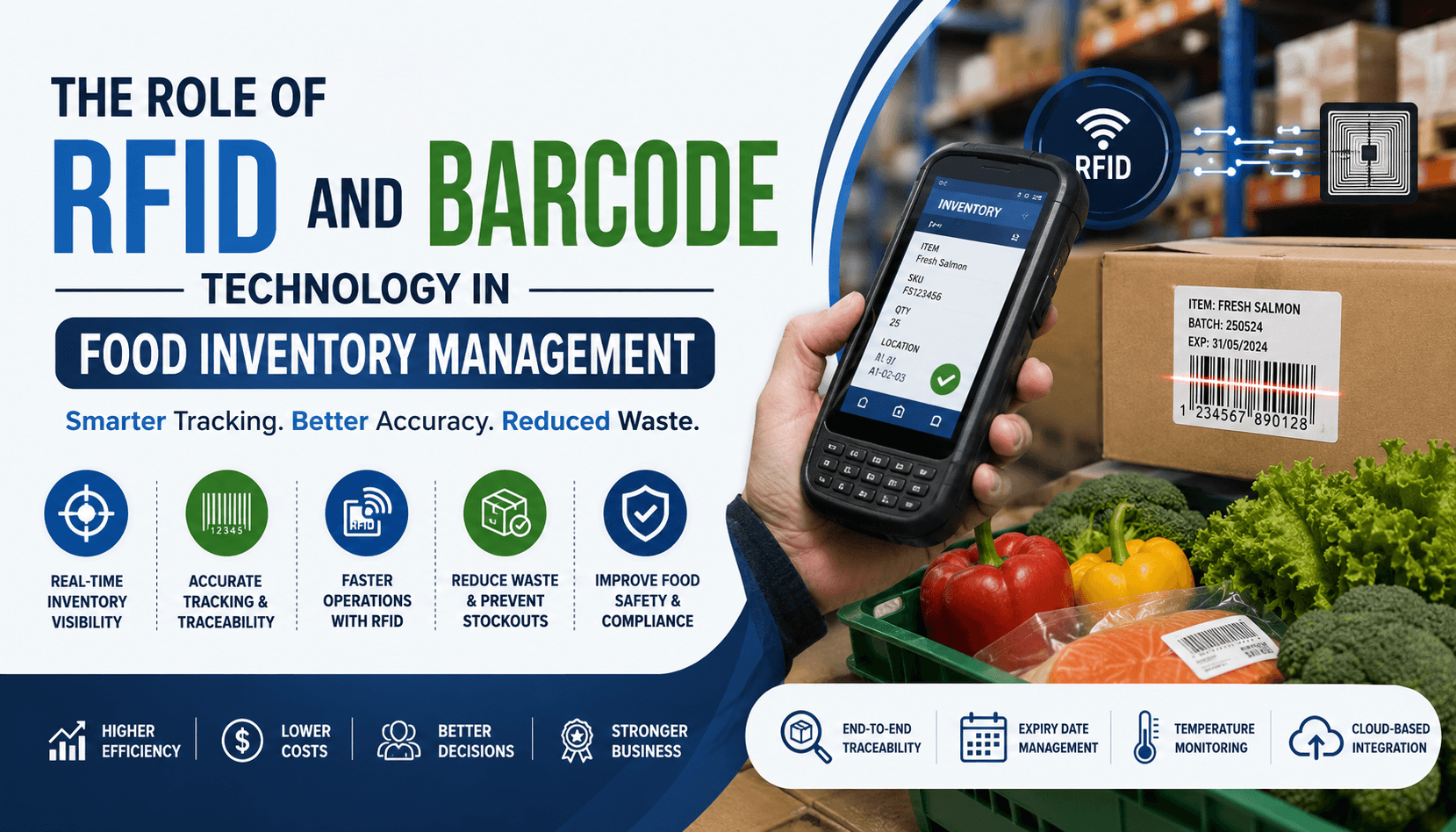
Managing food inventory efficiently is one of the biggest challenges for restaurants, food manufacturers, supermarkets, cloud kitchens, and warehouses. Traditional inventory methods often lead to stock inaccuracies, food wastage, expired products, and operational inefficiencies. To overcome these issues, businesses are increasingly adopting RFID and barcode technology in food inventory management systems.
These technologies help organizations automate inventory tracking, improve accuracy, reduce human errors, and enhance supply chain visibility. In today’s fast-moving food industry, real-time inventory monitoring has become essential for maintaining profitability and food safety standards.
This article explores the role of RFID and barcode technology in modern food inventory management and how they help businesses optimize operations.
What is Food Inventory Management?
Food inventory management is the process of tracking, storing, ordering, and controlling food stock throughout the supply chain. It involves monitoring raw materials, packaged food products, expiry dates, stock movement, and warehouse inventory levels.
An effective food inventory management system helps businesses:
- Reduce food wastage
- Prevent stock shortages
- Improve inventory accuracy
- Monitor expiry dates
- Optimize procurement
- Increase operational efficiency
- Ensure food safety compliance
Modern inventory systems use technologies like RFID and barcodes to automate these processes.
Understanding Barcode Technology in Food Inventory Management
Barcode technology uses machine-readable labels attached to food products and inventory items. These labels contain important information such as product ID, batch number, manufacturing date, and expiry date.
Barcode scanners read the encoded information and automatically update inventory records in the management system.
How Barcode Technology Works
- A barcode label is printed and attached to food products.
- The barcode scanner reads the code.
- The inventory software updates stock data automatically.
- Businesses can monitor inventory movement in real time.
Types of Barcodes Used in Food Inventory
- 1D Barcodes
- QR Codes
- UPC Codes
- Data Matrix Codes
Benefits of Barcode Technology in Food Inventory Management
Improved Inventory Accuracy
Manual inventory tracking often results in data entry errors. Barcode scanning significantly improves inventory accuracy by automating stock updates.
Faster Stock Management
Barcode scanners help employees quickly check inventory, reducing the time required for stock audits and warehouse operations.
Reduced Food Waste
Businesses can monitor product expiry dates and stock rotation more effectively, helping reduce food spoilage and waste.
Cost-Effective Implementation
Barcode systems are affordable and easy to implement for small and medium-sized businesses.
Better Traceability
Barcode technology helps track food products across the supply chain, improving transparency and recall management.
What is RFID Technology in Food Inventory Management?
RFID (Radio Frequency Identification) technology uses radio waves to identify and track inventory items automatically without direct line-of-sight scanning.
RFID tags are attached to food products, pallets, or containers, and RFID readers capture data remotely in real time.
Unlike barcode systems, RFID can scan multiple items simultaneously, making it highly efficient for large-scale operations.
How RFID Technology Works
- RFID tags are attached to food inventory items.
- RFID readers emit radio signals.
- Tags transmit stored data back to the reader.
- The inventory management system updates stock information instantly.
Types of RFID Tags
Passive RFID Tags
- Low-cost
- Powered by reader signals
- Suitable for general inventory tracking
Active RFID Tags
- Battery-powered
- Longer read range
- Used for high-value inventory monitoring
Benefits of RFID Technology in Food Inventory Management
Real-Time Inventory Visibility
RFID provides instant inventory updates, enabling businesses to monitor stock movement continuously.
Faster Inventory Audits
RFID readers can scan multiple items at once, significantly reducing inventory counting time.
Enhanced Food Safety
Businesses can track temperature-sensitive products and monitor cold chain compliance more efficiently.
Reduced Human Errors
RFID automation minimizes manual intervention and improves operational accuracy.
Better Supply Chain Transparency
RFID technology improves product traceability from suppliers to end customers.
Improved Warehouse Efficiency
Automated inventory tracking speeds up warehouse operations and improves productivity.
RFID vs Barcode Technology: Key Differences
| Feature | Barcode Technology | RFID Technology |
|---|---|---|
| Scanning Method | Requires line-of-sight | No line-of-sight required |
| Scanning Speed | One item at a time | Multiple items simultaneously |
| Data Storage | Limited | Larger storage capacity |
| Read Range | Short | Long-range reading |
| Cost | Lower | Higher |
| Automation Level | Moderate | High |
| Durability | Can be damaged easily | More durable |
Applications of RFID and Barcode Technology in Food Industry
Restaurants and Cloud Kitchens
- Ingredient tracking
- Stock monitoring
- Expiry date management
- Waste reduction
Supermarkets and Grocery Stores
- Shelf inventory tracking
- Automated stock replenishment
- Product traceability
Food Manufacturing
- Raw material tracking
- Batch management
- Supply chain monitoring
Warehouses and Distribution Centers
- Automated inventory audits
- Real-time shipment tracking
- Faster order fulfillment
How RFID and Barcode Systems Improve Food Safety
Food safety is critical in the food industry. RFID and barcode systems help businesses comply with food safety regulations by improving product traceability and monitoring.
Key benefits include:
- Faster product recalls
- Accurate batch tracking
- Expiry date monitoring
- Temperature-sensitive inventory tracking
- Regulatory compliance support
Challenges in Implementing RFID and Barcode Technology
Initial Setup Cost
RFID systems can require significant investment in hardware and software infrastructure.
Integration Complexity
Businesses may face challenges integrating inventory systems with ERP and POS platforms.
Employee Training
Staff training is essential for successful implementation and system adoption.
Data Management
Large-scale inventory systems generate substantial data that must be managed effectively.
Future of Food Inventory Management Technology
The future of food inventory management is becoming more intelligent with technologies like:
- Artificial Intelligence (AI)
- IoT-enabled smart sensors
- Cloud-based inventory platforms
- Predictive analytics
- Automated warehouse systems
Combining RFID and barcode technology with AI-driven analytics enables businesses to improve forecasting, reduce losses, and optimize supply chain performance.
Choosing the Right Technology for Your Business
Businesses should consider several factors before selecting RFID or barcode systems:
- Business size
- Inventory volume
- Budget
- Automation requirements
- Operational complexity
- Supply chain visibility needs
Small businesses may prefer barcode systems due to lower costs, while large enterprises often benefit more from RFID automation.
Conclusion
RFID and barcode technology are transforming food inventory management by improving accuracy, efficiency, and real-time visibility. These technologies help businesses reduce food waste, optimize stock management, improve food safety, and enhance supply chain operations.
As the food industry continues to evolve, adopting smart inventory management solutions will become essential for maintaining competitiveness and operational excellence.
Businesses that invest in RFID and barcode-enabled food inventory management systems can achieve better inventory control, increased profitability, and improved customer satisfaction.
FAQs
What is the main difference between RFID and barcode technology?
Barcode technology requires line-of-sight scanning, while RFID can scan multiple items remotely without direct visibility.
Is RFID better than barcode for food inventory management?
RFID offers higher automation and real-time tracking, but barcode systems are more affordable for small businesses.
How does barcode technology reduce food waste?
Barcode systems help track expiry dates and stock rotation, reducing spoilage and overstocking.
Can RFID improve food safety compliance?
Yes, RFID improves product traceability, batch tracking, and cold chain monitoring for better compliance.
Which industries use RFID and barcode inventory systems?
Restaurants, supermarkets, food manufacturers, warehouses, and distribution centers widely use these technologies.
Are RFID systems expensive to implement?
RFID systems generally have higher setup costs compared to barcode systems but offer greater automation benefits.
How do RFID and barcode systems improve supply chain visibility?
They provide real-time inventory tracking, product traceability, and automated stock monitoring across the supply chain.
