

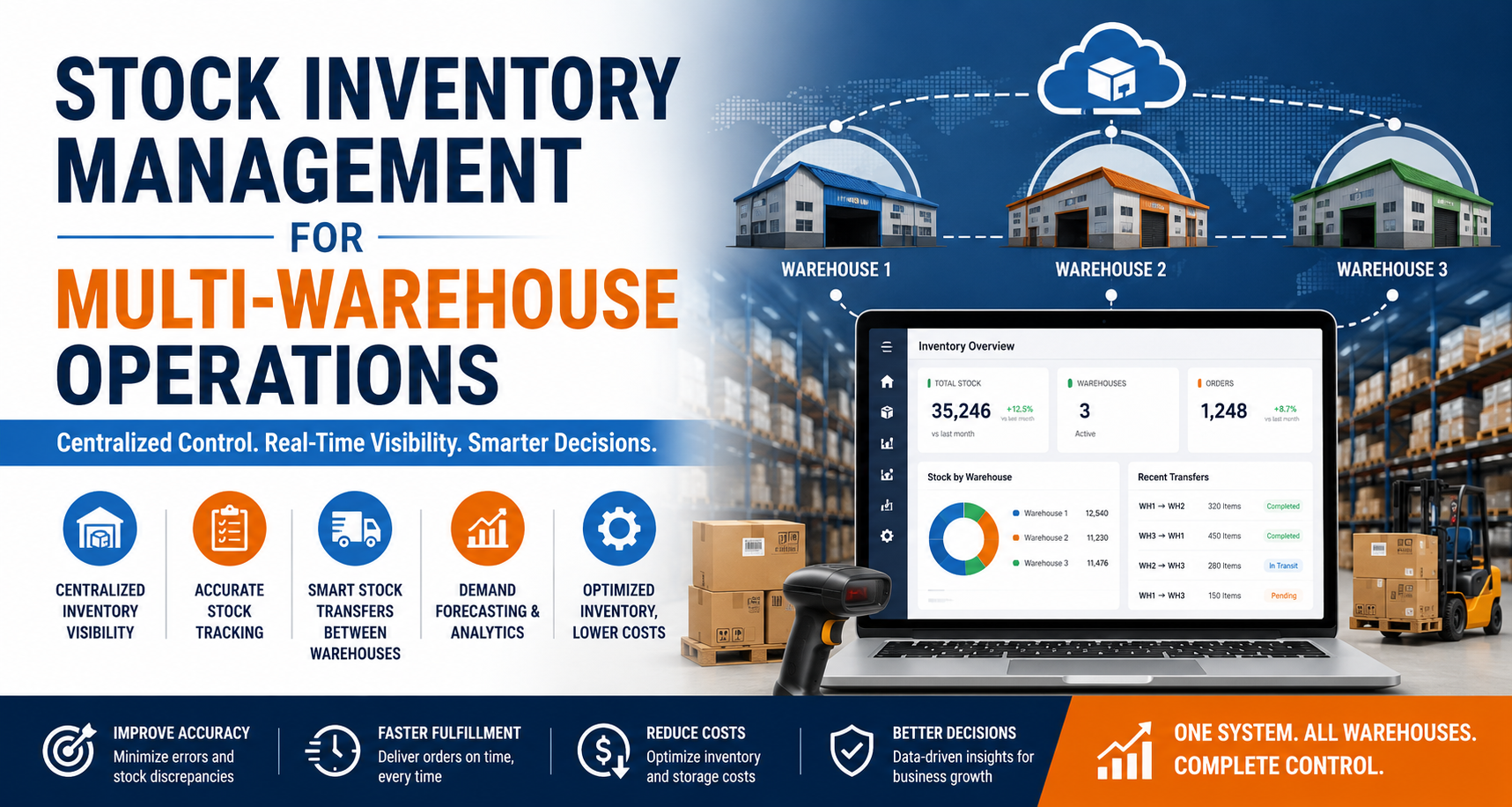
As businesses expand across regions, managing inventory from a single warehouse is no longer sufficient. Companies operating multiple warehouses often face challenges such as inventory discrepancies, stockouts, overstocking, delayed fulfillment, and lack of real-time visibility. A robust Stock Inventory Management System for Multi-Warehouse Operations helps organizations streamline inventory control, improve stock accuracy, and optimize warehouse performance.
Whether you operate in manufacturing, retail, e-commerce, logistics, or distribution, implementing an advanced inventory management solution can significantly improve operational efficiency and customer satisfaction.
What Is Multi-Warehouse Inventory Management?
Multi-warehouse inventory management refers to the process of tracking, controlling, and optimizing inventory across multiple storage locations from a centralized platform. It enables businesses to monitor stock levels, inventory movement, transfers, and replenishment activities in real time.
A modern stock inventory management system provides complete visibility into inventory across all warehouses, helping businesses make informed decisions and improve supply chain efficiency.
Common Challenges in Multi-Warehouse Operations
Managing inventory across multiple locations comes with several operational challenges:
1. Lack of Inventory Visibility
Without centralized tracking, businesses struggle to determine stock availability across warehouses, leading to inaccurate inventory records.
2. Overstocking and Stockouts
Poor inventory planning often results in excess inventory at one location while another warehouse experiences stock shortages.
3. Inefficient Stock Transfers
Manual processes make it difficult to track inventory transfers between warehouses, causing delays and inventory inaccuracies.
4. Order Fulfillment Delays
Without real-time inventory visibility, businesses may ship products from distant warehouses, increasing delivery times and transportation costs.
5. Higher Operational Costs
Maintaining excess inventory and inefficient warehouse operations can significantly increase storage and logistics expenses.
Benefits of a Stock Inventory Management System for Multi-Warehouse Operations
Centralized Inventory Visibility
A centralized inventory management platform provides real-time visibility into stock levels across all warehouses. Managers can instantly identify inventory availability, movement, and location.
Improved Inventory Accuracy
Automated inventory tracking minimizes human errors and ensures accurate stock records across multiple locations.
Faster Order Fulfillment
The system automatically identifies the nearest warehouse with available inventory, enabling faster order processing and reduced delivery times.
Optimized Inventory Distribution
Businesses can balance stock levels across warehouses and prevent overstocking or understocking situations.
Reduced Operational Costs
Improved inventory control reduces carrying costs, storage expenses, and unnecessary inventory purchases.
Better Demand Forecasting
Advanced analytics help businesses predict demand patterns and optimize inventory replenishment strategies.
Key Features of a Multi-Warehouse Inventory Management System
Real-Time Inventory Tracking
Monitor inventory movement across all warehouse locations from a single dashboard.
Warehouse-Wise Stock Management
Track inventory levels separately for each warehouse while maintaining centralized visibility.
Automated Stock Transfers
Manage and track inventory transfers between warehouses efficiently.
Barcode and RFID Integration
Leverage barcode and RFID technology to improve inventory accuracy and automate stock tracking.
Inventory Alerts and Notifications
Receive automatic alerts for low stock levels, reorder points, and inventory discrepancies.
Demand Forecasting and Analytics
Use historical data and AI-powered insights to optimize inventory planning.
ERP and Supply Chain Integration
Integrate inventory management with ERP, procurement, warehouse management, and logistics systems.
How RFID Enhances Multi-Warehouse Inventory Management
RFID technology enables automated and real-time inventory tracking without manual scanning. Businesses can instantly identify inventory location, movement, and status across multiple warehouses.
RFID Benefits Include:
- Real-time inventory visibility
- Faster stock counting
- Reduced inventory errors
- Improved warehouse productivity
- Enhanced asset traceability
- Automated receiving and dispatch operations
Organizations managing large-scale inventory often use RFID-based inventory management systems to improve operational efficiency and supply chain visibility.
Best Practices for Managing Inventory Across Multiple Warehouses
Implement Centralized Inventory Control
Use a unified inventory management platform that provides visibility across all locations.
Automate Inventory Tracking
Deploy barcode or RFID technologies to reduce manual errors and improve inventory accuracy.
Optimize Warehouse Allocation
Store inventory strategically based on customer demand and geographic distribution.
Monitor Inventory KPIs
Track key performance indicators such as inventory turnover, stock accuracy, order fulfillment rates, and carrying costs.
Enable Real-Time Reporting
Use dashboards and analytics tools to monitor warehouse performance and inventory trends.
Conduct Regular Audits
Perform cycle counts and inventory audits to maintain accurate stock records.
Industries That Benefit from Multi-Warehouse Inventory Management
Manufacturing
Manage raw materials, work-in-progress inventory, and finished goods across multiple production facilities.
Retail
Maintain optimal stock levels across stores, distribution centers, and fulfillment hubs.
E-Commerce
Enable faster order fulfillment and improve customer satisfaction through distributed inventory management.
Logistics and Distribution
Track inventory movement across warehouses, transportation hubs, and distribution centers.
Healthcare
Ensure accurate inventory control of medical supplies and pharmaceutical products across multiple locations.
Future Trends in Multi-Warehouse Inventory Management
Emerging technologies are transforming inventory management capabilities:
- Artificial Intelligence (AI) for demand forecasting
- Internet of Things (IoT) for real-time monitoring
- RFID-enabled inventory automation
- Cloud-based inventory management platforms
- Predictive analytics for inventory optimization
- Digital twin technology for warehouse operations
These innovations help businesses achieve greater visibility, efficiency, and scalability in multi-warehouse operations.
Conclusion
Managing inventory across multiple warehouses requires real-time visibility, accurate stock tracking, and efficient inventory control processes. A modern Stock Inventory Management System empowers businesses to optimize inventory distribution, reduce operational costs, improve order fulfillment, and enhance customer satisfaction.
By leveraging technologies such as RFID, barcode systems, AI, and cloud-based inventory management platforms, organizations can transform their multi-warehouse operations into a highly efficient and data-driven supply chain ecosystem.
Businesses that invest in advanced inventory management solutions today will be better positioned to meet growing customer demands, improve operational agility, and gain a competitive advantage in the evolving marketplace.
FAQs
What is multi-warehouse inventory management?
Multi-warehouse inventory management is the process of tracking and controlling inventory across multiple warehouse locations through a centralized system. It provides real-time visibility into stock levels, inventory movement, transfers, and replenishment activities to improve operational efficiency and inventory accuracy.
Why is a stock inventory management system important for multiple warehouses?
A stock inventory management system helps businesses maintain accurate inventory records, reduce stockouts and overstocking, optimize warehouse distribution, improve order fulfillment speed, and lower inventory carrying costs across multiple warehouse locations.
How does a multi-warehouse inventory management system improve stock visibility?
The system provides a centralized dashboard that displays real-time inventory levels across all warehouse locations. Businesses can instantly check stock availability, monitor inventory movement, track transfers, and make faster inventory allocation decisions.
Can inventory be transferred between warehouses automatically?
Yes. Modern inventory management systems support automated inter-warehouse stock transfers. They track transfer requests, approvals, shipment status, and inventory updates, ensuring accurate stock records across all warehouse locations.
How does RFID improve multi-warehouse inventory management?
RFID technology enables automatic and real-time inventory tracking without manual scanning. It improves inventory accuracy, speeds up stock counting, reduces human errors, enhances traceability, and provides better visibility across multiple warehouse operations.
What are the biggest challenges in managing inventory across multiple warehouses?
Common challenges include inventory discrepancies, lack of stock visibility, inefficient warehouse transfers, order fulfillment delays, excess inventory, stock shortages, and higher storage and transportation costs due to poor inventory coordination.
Can a stock inventory management system integrate with ERP software?
Yes. Most advanced inventory management systems integrate with ERP, warehouse management, procurement, accounting, and logistics platforms. This integration ensures seamless data synchronization and improves overall supply chain visibility and operational efficiency.
How does multi-warehouse inventory management reduce operational costs?
It reduces costs by optimizing stock distribution, minimizing excess inventory, improving warehouse utilization, reducing manual processes, preventing stock losses, and enabling faster and more efficient order fulfillment across warehouse locations.
Which industries benefit from multi-warehouse inventory management systems?
Industries such as manufacturing, retail, e-commerce, logistics, distribution, healthcare, pharmaceuticals, automotive, FMCG, and wholesale businesses benefit significantly from multi-warehouse inventory management systems due to their complex inventory operations.
How do I choose the right multi-warehouse inventory management system?
Choose a system that offers real-time inventory tracking, warehouse-wise stock management, barcode or RFID integration, automated stock transfers, demand forecasting, analytics, ERP integration, cloud accessibility, and scalability to support future business growth.
