

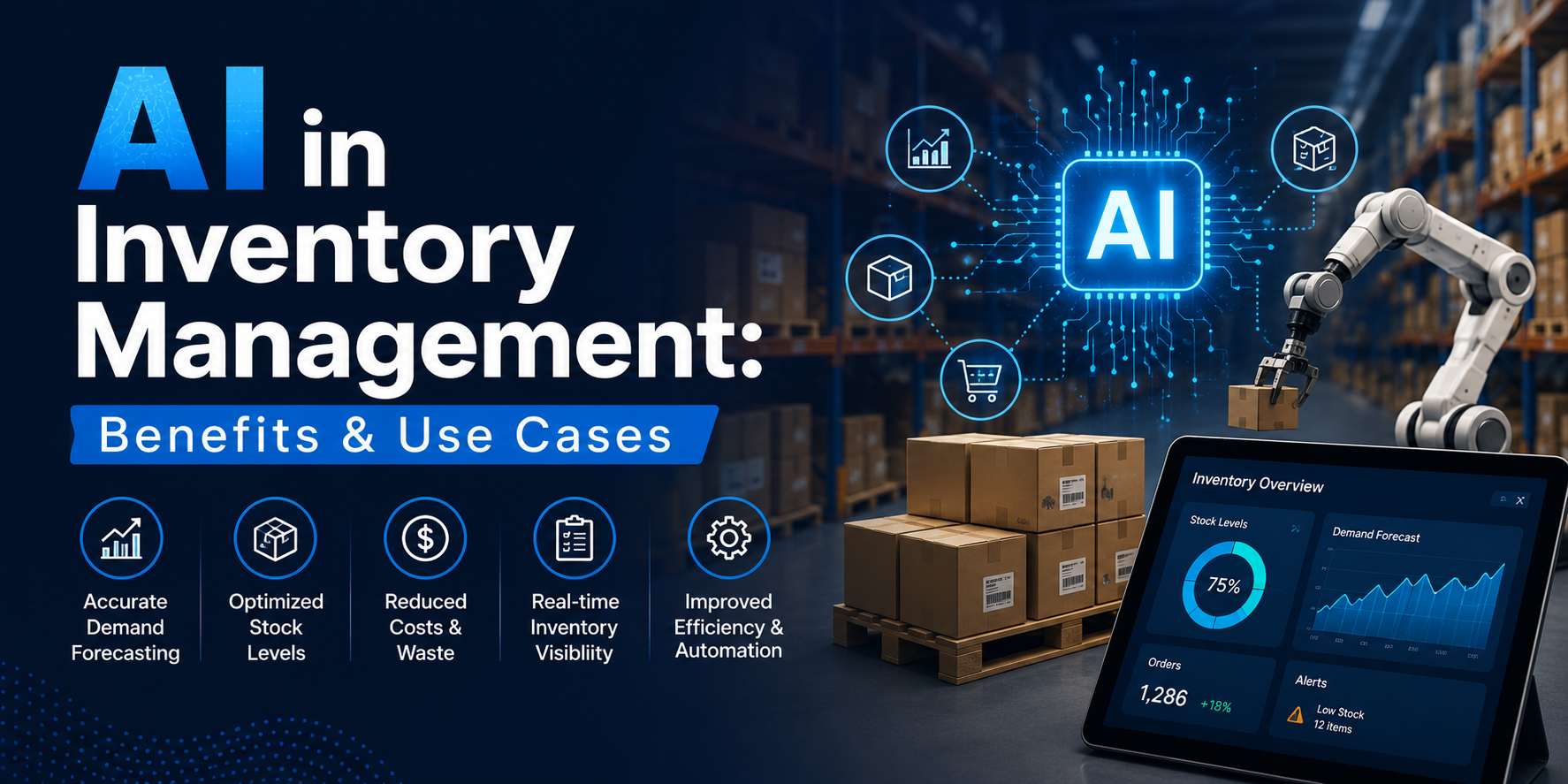
Inventory management is one of the most critical operations in modern businesses. From warehouses and retail stores to manufacturing units and logistics companies, maintaining the right stock levels directly impacts operational efficiency and customer satisfaction. Traditional inventory methods often struggle with inaccurate forecasting, stock shortages, overstocking, and manual errors.
Today, Artificial Intelligence (AI) is transforming inventory management by enabling smarter forecasting, real-time tracking, automated replenishment, and data-driven decision-making. Businesses are adopting AI-powered inventory solutions to improve productivity, reduce costs, and optimize supply chain operations.
What is AI in inventory management?
AI in inventory management refers to the use of artificial intelligence technologies such as machine learning, predictive analytics, computer vision, and automation to monitor, analyze, and optimize inventory operations.
AI systems can process large amounts of inventory data in real time and provide intelligent insights for:
- Demand forecasting
- Stock optimization
- Automated inventory tracking
- Warehouse automation
- Predictive maintenance
- Supply chain visibility
These systems help businesses make faster and more accurate inventory decisions.
Key Benefits of AI in Inventory Management
1. Accurate Demand Forecasting
One of the biggest advantages of AI is its ability to predict future demand using historical sales data, seasonal trends, customer behavior, and market patterns.
AI algorithms analyze:
- Sales history
- Seasonal demand
- Regional buying trends
- Market fluctuations
- Supplier performance
This helps businesses maintain optimal stock levels and avoid inventory shortages or excess inventory.
Benefits:
- Better inventory planning
- Reduced stockouts
- Improved customer satisfaction
- Lower carrying costs
2. Real-Time Inventory Visibility
AI-powered inventory systems provide real-time visibility into stock levels across warehouses, retail stores, and supply chain networks.
Using technologies such as:
- RFID
- Barcode systems
- IoT sensors
- AI cameras
Businesses can track inventory movement instantly and reduce manual monitoring efforts.
Benefits:
- Live stock monitoring
- Faster inventory updates
- Improved warehouse accuracy
- Better asset tracking
3. Reduced Overstocking and Waste
Excess inventory increases storage costs and leads to product wastage, especially in industries like retail, healthcare, and food supply chains.
AI helps businesses maintain the right inventory balance by:
- Predicting demand fluctuations
- Monitoring slow-moving products
- Recommending stock adjustments
Benefits:
- Lower warehouse costs
- Reduced inventory waste
- Improved cash flow
- Better stock utilization
4. Automated Inventory Replenishment
AI systems can automatically trigger purchase orders when inventory reaches predefined thresholds.
Smart replenishment systems consider:
- Lead times
- Supplier performance
- Current demand
- Delivery schedules
This automation reduces manual intervention and ensures uninterrupted supply chain operations.
Benefits:
- Faster procurement
- Reduced human errors
- Continuous inventory availability
- Efficient supplier coordination
5. Improved Warehouse Efficiency
AI-powered warehouse management systems optimize storage locations, picking routes, and inventory movement.
Combined with robotics and automation, AI can:
- Improve picking accuracy
- Reduce warehouse travel time
- Optimize storage space
- Increase order fulfillment speed
Benefits:
- Faster warehouse operations
- Improved worker productivity
- Reduced operational delays
- Better order accuracy
6. Better Decision-Making with Data Analytics
AI provides advanced analytics and actionable insights for inventory managers.
Businesses can analyze:
- Product demand trends
- Inventory turnover rates
- Supplier performance
- Warehouse efficiency metrics
This helps organizations make smarter business decisions based on real-time data.
Benefits:
- Improved operational planning
- Enhanced business intelligence
- Faster strategic decisions
- Better inventory optimization
Use Cases of AI in Inventory Management
Retail Inventory Management
Retail businesses use AI to:
- Predict customer demand
- Optimize stock levels
- Prevent out-of-stock situations
- Improve omnichannel inventory visibility
AI helps retailers deliver better shopping experiences while reducing operational costs.
Warehouse Automation
Warehouses use AI for:
- Automated picking systems
- Smart inventory tracking
- AI-powered surveillance
- Robotic inventory handling
This improves warehouse productivity and reduces manual labor dependency.
Manufacturing Inventory Optimization
Manufacturing industries use AI to:
- Manage raw material inventory
- Track production supplies
- Predict maintenance requirements
- Optimize production planning
AI ensures smooth manufacturing operations with minimal downtime.
E-Commerce Inventory Management
E-commerce companies rely on AI to manage high-volume inventory operations and rapidly changing customer demands.
AI helps:
- Optimize fulfillment centers
- Improve delivery efficiency
- Forecast seasonal demand
- Reduce return-related inventory issues
Healthcare and Pharmaceutical Inventory
Hospitals and pharmaceutical companies use AI for:
- Medicine stock tracking
- Expiry date monitoring
- Medical equipment inventory management
- Supply chain compliance
AI reduces wastage and improves patient care efficiency.
Technologies Used in AI Inventory Management
Several advanced technologies support AI-based inventory systems:
Machine Learning
Analyzes historical data to predict future inventory requirements.
Computer Vision
Uses AI cameras for automated stock monitoring and warehouse surveillance.
RFID Technology
Provides real-time inventory tracking using radio frequency identification tags.
Internet of Things (IoT)
IoT sensors collect live inventory data from warehouses and supply chains.
Predictive Analytics
Forecasts inventory demand and identifies operational risks.
Challenges of AI in Inventory Management
While AI offers major advantages, businesses may face some challenges during implementation:
- High initial investment
- Integration with existing ERP systems
- Data quality and accuracy issues
- Employee training requirements
- Cybersecurity concerns
However, long-term operational savings and efficiency improvements often outweigh these challenges.
Future of AI in Inventory Management
The future of inventory management is becoming increasingly intelligent and automated. Businesses are rapidly adopting AI-driven technologies to improve supply chain visibility and operational efficiency.
Future trends include:
- Autonomous warehouses
- AI-powered drones for inventory scanning
- Predictive supply chain analytics
- Smart robotic fulfillment systems
- Hyper-automation in logistics
AI will continue to play a vital role in creating faster, smarter, and more efficient inventory operations.
Conclusion
AI in inventory management is transforming how businesses track, manage, and optimize inventory operations. From real-time visibility and demand forecasting to warehouse automation and predictive analytics, AI helps organizations reduce costs, improve efficiency, and enhance customer satisfaction.
Businesses across retail, manufacturing, healthcare, logistics, and e-commerce are increasingly investing in AI-powered inventory systems to stay competitive in the digital era.
Companies that adopt AI-driven inventory solutions today will be better prepared for the future of intelligent supply chain management.
Frequently Asked Questions (FAQs)
1. What is AI in inventory management?
AI in inventory management uses artificial intelligence technologies to automate and optimize inventory tracking, forecasting, replenishment, and warehouse operations.
2. How does AI improve inventory accuracy?
AI improves inventory accuracy by analyzing real-time data from RFID, IoT devices, barcode systems, and AI cameras to reduce manual errors and provide live stock visibility.
3. Which industries use AI inventory management solutions?
Industries including retail, manufacturing, logistics, healthcare, e-commerce, and warehousing widely use AI inventory management systems.
4. Can AI reduce inventory costs?
Yes, AI helps reduce inventory costs by minimizing overstocking, preventing stock shortages, optimizing warehouse operations, and improving demand forecasting.
5. What technologies are used in AI inventory systems?
AI inventory systems commonly use:
- Machine learning
- RFID technology
- IoT sensors
- Computer vision
- Predictive analytics
- Warehouse automation tools
6. How does AI help in warehouse automation?
AI optimizes picking routes, automates inventory tracking, improves storage management, and enhances robotic warehouse operations for faster order fulfillment.
7. Is AI inventory management suitable for small businesses?
Yes, many scalable AI inventory solutions are available for small and medium-sized businesses to improve inventory control and operational efficiency.
8. What is predictive inventory management?
Predictive inventory management uses AI and analytics to forecast future stock requirements based on sales trends, customer demand, and market conditions.
9. Can AI integrate with ERP and warehouse management systems?
Yes, modern AI inventory solutions can integrate with ERP, WMS, SCM, and other enterprise software systems for centralized operations management.
10. What is the future of AI in inventory management?
The future includes autonomous warehouses, AI-powered robotics, predictive supply chains, smart fulfillment systems, and fully automated inventory operations.
