

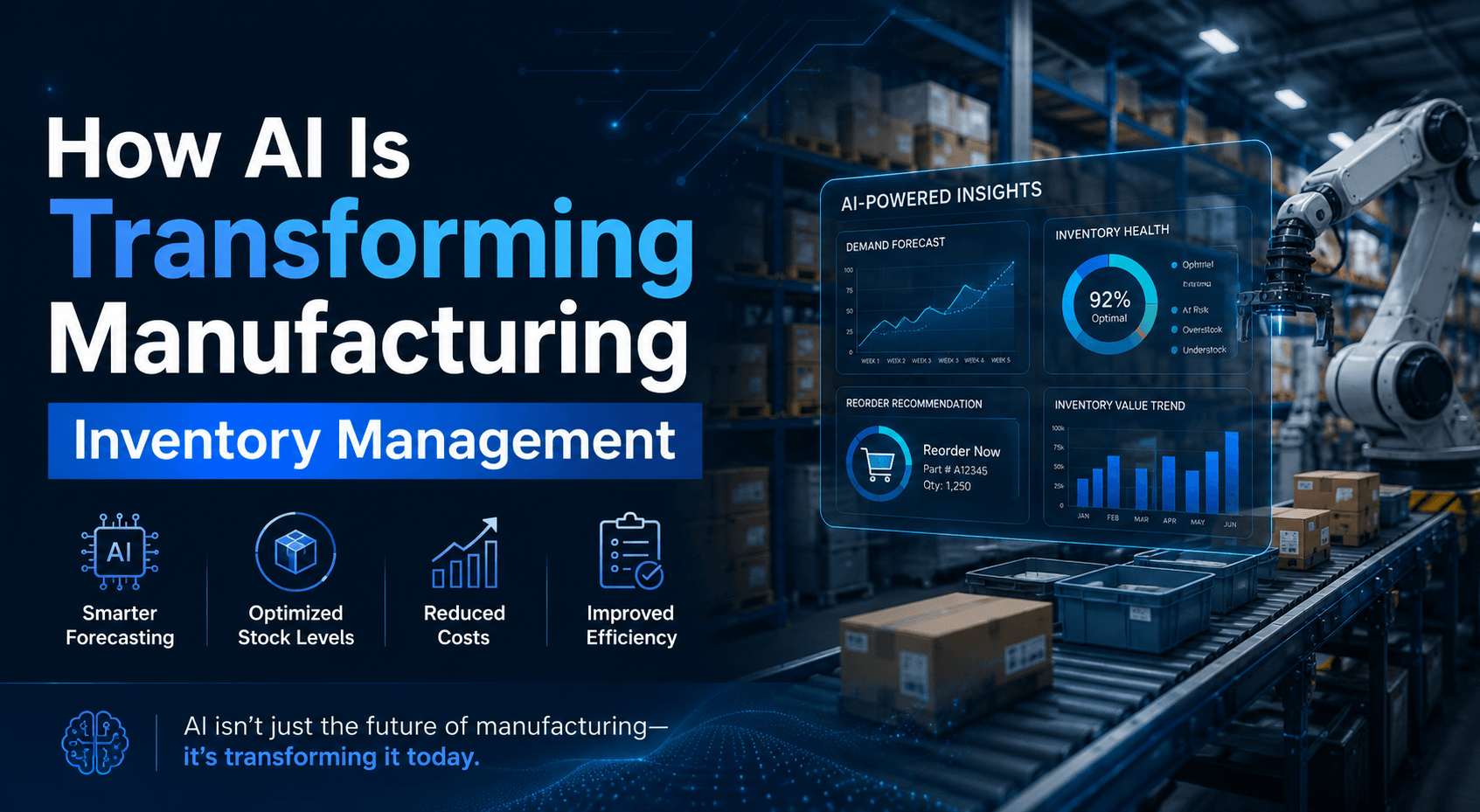
Manufacturing inventory management is no longer just about tracking raw materials and finished goods. Modern manufacturers are dealing with volatile demand, supply chain disruptions, rising carrying costs, production variability, and increasing customer expectations. Traditional inventory management methods often struggle to provide the speed, accuracy, and predictive capabilities needed in today’s manufacturing environment.
Artificial intelligence (AI) is changing this landscape by enabling manufacturers to move from reactive inventory management to predictive and intelligent inventory optimization. AI-powered inventory systems can forecast demand, optimize stock levels, detect anomalies, automate replenishment, improve warehouse operations, and provide real-time visibility across the manufacturing supply chain.
In this article, we explore how AI is transforming manufacturing inventory management, the technologies involved, practical use cases, implementation strategies, and the measurable business benefits manufacturers can achieve.
Why traditional manufacturing inventory management falls short
Many manufacturing companies still rely heavily on ERP systems, spreadsheets, manual inventory checks, periodic stock audits, and historical consumption data. While these methods may work in stable environments, they often create challenges such as excess inventory, stockouts, inaccurate inventory records, slow decision-making, poor demand forecasting, inefficient warehouse operations, production delays, and high carrying costs.
A traditional inventory system typically answers questions such as how much inventory is currently available and where inventory is located. An AI-powered inventory system answers much more valuable questions: what inventory will be needed next week, which materials are likely to experience shortages, how supplier delays will affect production, what the optimal reorder quantity is, and which inventory items are at risk of becoming obsolete.
This shift from descriptive to predictive inventory management is the key transformation AI brings to manufacturing.
What is AI-powered manufacturing inventory management?
AI-powered manufacturing inventory management uses machine learning, predictive analytics, computer vision, IoT data, and intelligent automation to optimize inventory decisions across the manufacturing operation.
Instead of relying only on historical averages, AI continuously analyzes multiple data sources, including sales orders, production schedules, supplier lead times, raw material consumption, machine utilization, warehouse movement, seasonal demand patterns, transportation delays, and external market factors.
The AI system identifies patterns, predicts future inventory requirements, recommends actions, and in many cases automates inventory decisions.
How AI transforms inventory management
Intelligent demand forecasting
Demand forecasting is one of the most important inventory functions in manufacturing. Traditional forecasting often depends on historical sales trends and manual planning. AI forecasting models can analyze hundreds of variables simultaneously.
An AI forecasting system can consider historical demand, seasonal patterns, promotional activities, economic indicators, customer behavior, production constraints, supplier performance, and market trends.
For example, a manufacturer producing industrial components may experience demand spikes from infrastructure projects, government tenders, and export orders. AI can detect these patterns earlier than traditional forecasting methods and recommend inventory adjustments before shortages occur.
More accurate forecasting helps reduce stockouts, lower safety stock requirements, improve production planning, decrease excess inventory, and improve customer service levels.
Inventory optimization
Manufacturers often struggle with balancing inventory availability and inventory cost. Holding too much inventory increases working capital and storage costs. Holding too little inventory creates production disruptions.
AI continuously optimizes inventory levels for raw materials, work-in-progress inventory, finished goods, spare parts, safety stock, and slow-moving inventory.
Instead of using fixed reorder points, AI dynamically adjusts inventory targets based on changing demand patterns, supplier reliability, production schedules, and lead time variability.
For example, if a supplier begins delivering materials with increasing delays, AI can automatically recommend increasing safety stock for critical components while reducing inventory for stable suppliers.
Predictive replenishment
Traditional replenishment systems often trigger orders based on predefined reorder points. AI makes replenishment decisions more intelligently.
AI can evaluate current inventory levels, predicted demand, supplier lead times, purchase order status, production schedules, transportation constraints, and inventory carrying costs.
The system can recommend when to reorder, how much to order, which supplier to choose, and whether alternative materials should be considered.
This reduces emergency purchases, expedited shipping costs, production interruptions, and excess inventory accumulation.
Real-time inventory visibility
One of the biggest challenges in manufacturing is inventory visibility across warehouses, production lines, storage locations, and multiple facilities.
AI integrated with RFID, barcode systems, IoT sensors, and warehouse management systems provides real-time inventory visibility.
Manufacturers can monitor raw material availability, WIP inventory movement, finished goods inventory, warehouse occupancy, inventory aging, and inventory turnover.
Real-time visibility allows production planners to make faster decisions and respond quickly to supply chain disruptions.
AI-driven warehouse optimization
AI improves warehouse efficiency by optimizing inventory placement, picking routes, storage allocation, replenishment tasks, labor utilization, and material movement.
For example, AI can identify frequently used production materials and recommend placing them closer to manufacturing lines. It can also predict peak warehouse activity and optimize workforce scheduling.
Benefits include faster picking, reduced travel time, improved warehouse throughput, lower labor costs, and fewer inventory handling errors.
Detection of inventory anomalies
Inventory inaccuracies are common in manufacturing due to counting errors, misplaced materials, theft, damage, incorrect transactions, and production reporting issues.
AI can continuously analyze inventory movement patterns and detect anomalies such as unusual consumption spikes, unexpected inventory shrinkage, duplicate transactions, inconsistent stock movements, abnormal warehouse activity, and inventory mismatches.
Instead of waiting for monthly inventory audits, manufacturers receive immediate alerts when unusual inventory behavior occurs.
Reduction of obsolete inventory
Obsolete inventory ties up capital and occupies valuable warehouse space.
AI can identify inventory items with declining consumption, low production usage, excess stock accumulation, changing product demand, and upcoming engineering changes.
The system can recommend actions such as production consumption, inter-facility transfer, supplier return, promotional sales, or inventory liquidation.
This helps reduce inventory write-offs and improve inventory turnover.
AI technologies used in manufacturing inventory management
Machine learning
Machine learning algorithms analyze historical and real-time data to improve forecasting, inventory optimization, replenishment planning, and anomaly detection.
Predictive analytics
Predictive models forecast future inventory demand, supplier risks, lead time changes, and production material requirements.
Computer vision
AI-powered cameras can automatically monitor warehouse inventory, production materials, pallet movement, and inventory counting processes.
IoT sensors
IoT devices provide real-time information about inventory location, environmental conditions, equipment status, and material movement.
RFID integration
RFID provides automatic inventory tracking while AI analyzes RFID data to optimize inventory decisions and warehouse operations.
AI agents
AI agents can monitor inventory continuously, generate alerts, recommend replenishment actions, coordinate with procurement systems, and automate inventory workflows.
Practical manufacturing use cases
Raw material inventory optimization
A manufacturing plant using AI can predict raw material consumption based on production orders and automatically adjust procurement schedules.
Work-in-progress inventory management
AI can monitor production flow and identify bottlenecks causing WIP accumulation.
Spare parts inventory optimization
AI predicts equipment maintenance requirements and ensures critical spare parts are available without excessive inventory.
Multi-warehouse inventory balancing
Manufacturers with multiple facilities can use AI to optimize inventory distribution across locations.
Supplier risk management
AI evaluates supplier delivery performance and predicts potential material shortages.
AI and RFID together: a powerful combination
RFID provides accurate real-time inventory data. AI converts that data into intelligent decisions.
RFID tells manufacturers where inventory is. AI tells them what to do with it.
For example, RFID automatically tracks pallet movement, material consumption, warehouse transfers, and production line inventory. AI analyzes this data to predict shortages, optimize stock levels, identify slow-moving inventory, and improve production planning.
The combination of RFID and AI creates a highly automated and intelligent inventory ecosystem.
Business benefits of AI inventory management
Manufacturers implementing AI inventory systems often achieve measurable improvements across operations.
Common benefits include improved inventory accuracy, lower inventory carrying costs, reduced stockouts, higher inventory turnover, better production continuity, faster replenishment decisions, improved warehouse productivity, reduced obsolete inventory, better supplier performance, and improved working capital utilization.
These benefits directly impact profitability, operational efficiency, and customer satisfaction.
Implementation roadmap
Manufacturers should approach AI inventory transformation in phases.
Phase 1: Inventory assessment
Evaluate inventory accuracy, forecasting performance, stockout frequency, carrying costs, warehouse operations, and data quality.
Phase 2: Data integration
Connect ERP, WMS, RFID, barcode systems, production systems, procurement systems, and supplier data.
Phase 3: AI forecasting
Implement AI demand forecasting and inventory prediction models.
Phase 4: Inventory optimization
Deploy AI-based inventory optimization and replenishment recommendations.
Phase 5: Warehouse intelligence
Integrate AI with warehouse operations, RFID tracking, and material movement systems.
Phase 6: Autonomous inventory management
Implement AI agents and automated inventory workflows.
Common implementation challenges
Manufacturers may face challenges such as poor data quality, disconnected systems, inaccurate inventory records, lack of RFID or IoT infrastructure, limited AI expertise, resistance to operational changes, and integration complexity.
Successful AI implementation requires clean data, process standardization, cross-functional collaboration, and phased deployment.
The future of AI in manufacturing inventory management
The next generation of manufacturing inventory systems will become increasingly autonomous.
Future AI capabilities will include autonomous inventory planning, AI-driven procurement negotiation, digital twin inventory simulation, autonomous warehouse coordination, predictive supply chain orchestration, and self-optimizing inventory networks.
AI agents will continuously monitor inventory, coordinate with production planning, communicate with suppliers, optimize warehouse operations, and automatically resolve inventory exceptions.
Manufacturers will move from managing inventory to supervising intelligent inventory systems.
Conclusion
AI is fundamentally transforming manufacturing inventory management by replacing reactive inventory practices with predictive, intelligent, and increasingly autonomous decision-making.
Manufacturers can improve demand forecasting, optimize inventory levels, automate replenishment, enhance warehouse operations, reduce obsolete inventory, improve production continuity, and increase inventory accuracy through AI-powered inventory systems.
When combined with RFID, IoT, and real-time manufacturing data, AI provides end-to-end inventory intelligence that supports faster decisions and more resilient manufacturing operations.
For manufacturers looking to reduce inventory costs, improve operational efficiency, and build a smarter factory, AI-powered inventory management is no longer a future technology—it is a competitive advantage available today.
FAQs
1. What is AI-powered manufacturing inventory management?
AI-powered manufacturing inventory management uses artificial intelligence, machine learning, and predictive analytics to forecast demand, optimize inventory levels, automate replenishment, and improve inventory accuracy. It helps manufacturers make faster and more informed inventory decisions using real-time data.
2. How does AI improve inventory forecasting in manufacturing?
AI analyzes historical sales, production schedules, supplier lead times, seasonal demand patterns, and operational data to generate highly accurate demand forecasts. This helps manufacturers reduce stockouts, avoid overstocking, and improve production planning.
3. Can AI reduce inventory carrying costs?
Yes. AI helps optimize inventory levels by identifying excess stock, slow-moving materials, and unnecessary safety stock. By maintaining optimal inventory levels, manufacturers can reduce storage costs, working capital requirements, and inventory obsolescence.
4. How does AI work with RFID in manufacturing inventory management?
RFID provides real-time inventory tracking, while AI analyzes RFID data to predict inventory shortages, optimize stock levels, automate material movement, and improve warehouse efficiency. Together, they create a highly accurate and intelligent inventory management system.
5. Is AI suitable for small and medium-sized manufacturing businesses?
Yes. AI-based inventory solutions are increasingly available for small and medium manufacturers through cloud-based platforms and scalable software. Businesses can start with demand forecasting and inventory optimization before expanding to advanced AI automation.
6. What are the biggest benefits of AI in manufacturing inventory management?
The biggest benefits include improved inventory accuracy, better demand forecasting, reduced stockouts, lower carrying costs, optimized warehouse operations, faster replenishment decisions, and increased inventory turnover. These improvements directly support profitability and operational efficiency.
7. How can a manufacturer start implementing AI for inventory management?
Manufacturers should begin by assessing inventory challenges, improving data quality, integrating ERP and warehouse systems, and implementing AI-based demand forecasting. A phased approach allows businesses to test AI capabilities and gradually expand to inventory optimization and automated replenishment.
