

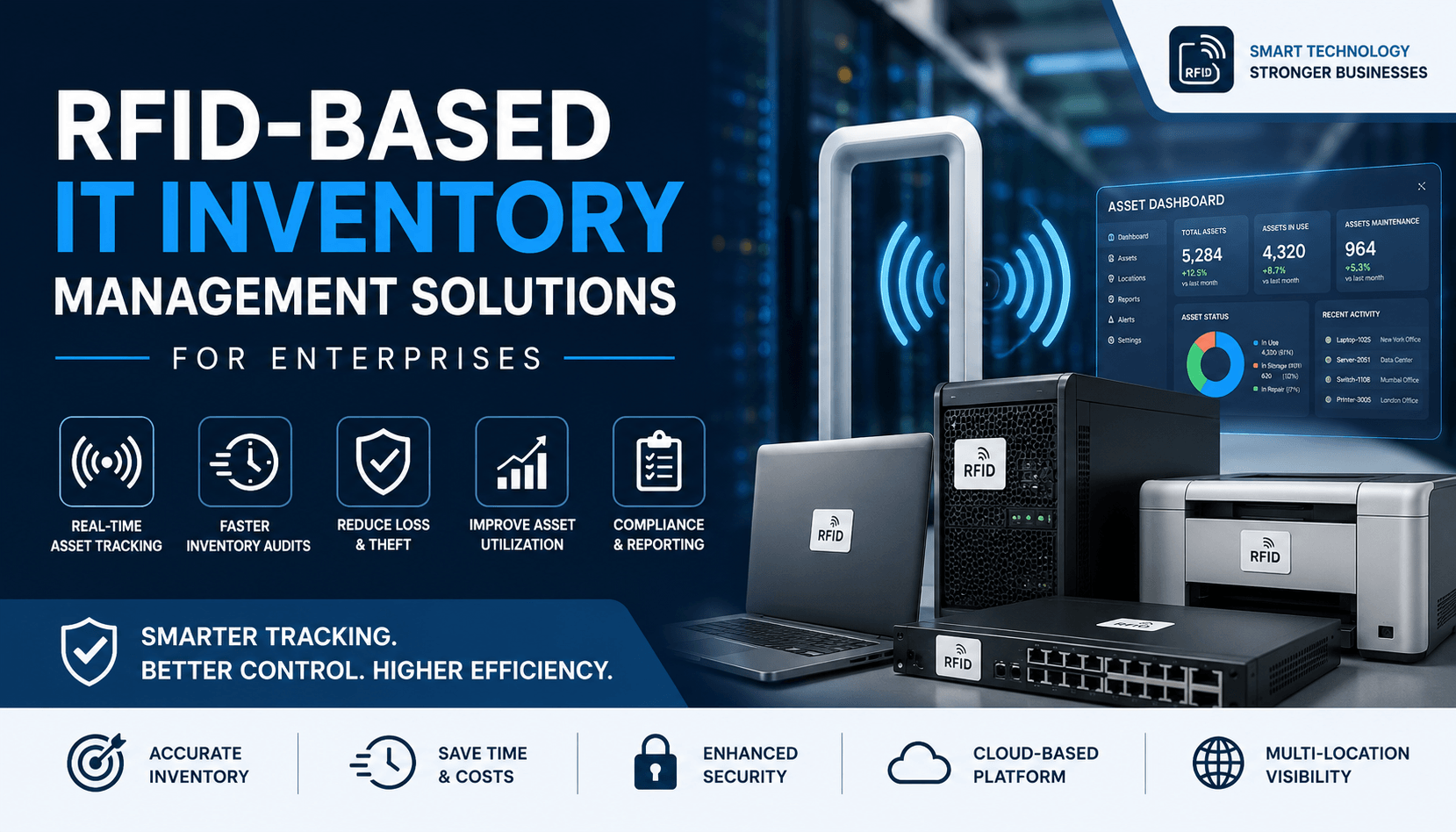
Managing IT assets across an enterprise can be challenging, especially when organizations operate multiple offices, data centers, warehouses, and remote work environments. Traditional inventory management methods often rely on manual audits, spreadsheets, or barcode systems that are time-consuming and prone to human error.
RFID-based IT Inventory Management Solutions provide enterprises with a smarter, faster, and more accurate way to track, monitor, and manage IT assets in real time. By leveraging Radio Frequency Identification (RFID) technology, organizations can automate asset tracking, improve visibility, reduce losses, and streamline inventory audits.
In this article, we’ll explore how RFID technology transforms IT inventory management, its benefits, implementation strategies, and why enterprises are increasingly adopting RFID-enabled solutions.
What is RFID-Based IT Inventory Management?
RFID (Radio Frequency Identification) is a wireless technology that uses radio waves to identify and track tagged assets automatically. In an IT inventory management system, RFID tags are attached to IT assets such as:
- Laptops
- Desktop computers
- Servers
- Networking equipment
- Printers
- Monitors
- Storage devices
- Mobile devices
- Data center equipment
RFID readers capture information from these tags without requiring direct line-of-sight, enabling rapid and automated inventory tracking.
Unlike barcode systems, RFID can scan multiple assets simultaneously, significantly reducing inventory management efforts.
Challenges in Traditional IT Inventory Management
Many enterprises still rely on manual asset tracking methods that create operational inefficiencies, including:
Inaccurate Asset Records
Manual updates often result in outdated or incorrect inventory information.
Time-Consuming Audits
Physical asset verification can take days or even weeks in large organizations.
Asset Loss and Theft
Lack of real-time visibility increases the risk of misplaced or stolen equipment.
Compliance Risks
Inaccurate asset records can lead to failed audits and regulatory compliance issues.
Poor Asset Utilization
Organizations often purchase unnecessary equipment because existing assets cannot be located easily.
RFID technology addresses these challenges by providing automated and real-time asset visibility.
How RFID-Based IT Inventory Management Works
RFID Tags
Each IT asset is equipped with a unique RFID tag containing identification information.
RFID Readers
Fixed or handheld RFID readers capture asset data automatically when assets move within a designated area.
Middleware Platform
RFID middleware processes collected data and communicates with inventory management software.
Centralized Dashboard
Asset information is displayed through a centralized dashboard, providing real-time visibility across locations.
Automated Reporting
The system generates reports on asset status, location, maintenance schedules, and audit records.
Key Benefits of RFID-Based IT Inventory Management Solutions
1. Real-Time Asset Visibility
RFID technology provides instant access to asset locations and status updates.
Benefits include:
- Faster asset identification
- Improved operational efficiency
- Enhanced decision-making
- Better asset accountability
Organizations can locate equipment within seconds rather than hours.
2. Faster Inventory Audits
Traditional inventory audits can consume significant resources.
With RFID:
- Multiple assets are scanned simultaneously.
- Inventory counts become highly accurate.
- Audit time can be reduced by up to 90%.
- Labor costs decrease significantly.
Enterprise teams can complete asset verification in minutes instead of days.
3. Reduced Asset Loss and Theft
RFID-enabled tracking helps organizations monitor asset movement continuously.
Advantages include:
- Unauthorized movement detection
- Automated alerts
- Enhanced security controls
- Reduced equipment loss
This is especially important for high-value IT assets and data center infrastructure.
4. Improved Asset Utilization
Many organizations struggle with underutilized or forgotten equipment.
RFID systems help enterprises:
- Identify unused assets
- Reallocate available equipment
- Extend asset lifecycle
- Reduce unnecessary purchases
This leads to substantial cost savings.
5. Enhanced Compliance and Audit Readiness
Regulatory frameworks often require accurate asset documentation.
RFID solutions support compliance by providing:
- Automated audit trails
- Asset history records
- Location tracking
- Maintenance documentation
This simplifies internal and external audits.
RFID Applications in Enterprise IT Asset Management
Data Center Asset Tracking
RFID enables real-time monitoring of:
- Servers
- Storage systems
- Network switches
- Rack-mounted equipment
Organizations can quickly identify hardware locations and improve infrastructure management.
Office IT Asset Management
Track employee devices including:
- Laptops
- Workstations
- Printers
- Mobile devices
This improves accountability and reduces asset loss.
IT Equipment Lifecycle Management
RFID supports every stage of asset lifecycle management:
- Procurement
- Deployment
- Maintenance
- Relocation
- Retirement
- Disposal
RFID vs Barcode for IT Inventory Management
| Feature | RFID | Barcode |
|---|---|---|
| Line-of-Sight Required | No | Yes |
| Multiple Asset Scanning | Yes | No |
| Scan Speed | Very Fast | Slow |
| Automation Level | High | Limited |
| Accuracy | High | Moderate |
| Real-Time Tracking | Yes | No |
| Labor Requirement | Low | High |
For large enterprises, RFID provides significantly greater scalability and efficiency.
Essential Features of an RFID-Based IT Inventory Management Solution
When selecting a solution, enterprises should look for:
Real-Time Asset Tracking
Continuous visibility across all locations.
Automated Inventory Audits
Rapid asset verification with minimal manual effort.
Asset Lifecycle Management
Complete tracking from acquisition to retirement.
Mobile RFID Integration
Support for handheld readers and mobile devices.
Cloud-Based Dashboard
Centralized access to inventory data.
Analytics and Reporting
Insights into asset utilization, movement, and performance.
ERP and ITSM Integration
Compatibility with enterprise systems and workflows.
Best Practices for RFID Implementation
Conduct Asset Assessment
Identify all IT assets requiring RFID tracking.
Choose the Right RFID Tags
Select tags suitable for:
- Indoor environments
- Data centers
- Office equipment
- High-value assets
Establish Tracking Zones
Define critical monitoring locations throughout facilities.
Integrate with Existing Systems
Connect RFID infrastructure with:
- ERP platforms
- IT Asset Management systems
- Service management software
Train Employees
Ensure IT and operations teams understand RFID processes and reporting tools.
Future Trends in RFID-Based IT Inventory Management
The future of enterprise asset management is being shaped by:
AI-Powered Asset Analytics
Predictive insights for asset maintenance and utilization.
IoT Integration
Combining RFID and IoT sensors for enhanced monitoring.
Cloud-Based Asset Intelligence
Centralized management across global locations.
Digital Twin Technology
Creating virtual representations of physical IT assets.
Automated Compliance Monitoring
Continuous tracking and reporting for regulatory requirements.
These innovations will further improve visibility, efficiency, and decision-making.
Conclusion
RFID-Based IT Inventory Management Solutions are transforming how enterprises track and manage IT assets. By automating inventory processes, improving asset visibility, reducing losses, and enabling real-time monitoring, RFID technology delivers substantial operational and financial benefits.
As organizations continue their digital transformation journeys, RFID-enabled inventory management will become a critical component of efficient IT asset management strategies. Enterprises that adopt RFID solutions today can gain greater control over their assets, improve compliance, and achieve long-term cost savings while enhancing operational efficiency.
Whether managing a corporate office, data center, manufacturing facility, or multi-location enterprise, RFID technology provides the accuracy, scalability, and automation needed for modern IT inventory management.
Frequently Asked Questions
1. What is RFID-based IT inventory management?
RFID-based IT inventory management is a system that uses Radio Frequency Identification (RFID) technology to automatically track, identify, and manage IT assets such as laptops, servers, networking devices, printers, and other equipment. RFID tags attached to assets communicate with RFID readers, providing real-time visibility into asset location, movement, and status without manual intervention.
2. How does RFID technology improve IT inventory management?
RFID technology automates asset tracking and inventory audits by enabling multiple assets to be scanned simultaneously without requiring direct line-of-sight. This improves inventory accuracy, reduces manual labor, minimizes asset loss, and provides real-time visibility across enterprise environments.
3. What types of IT assets can be tracked using RFID?
RFID can be used to track a wide range of IT assets, including:
- Laptops and desktops
- Servers and storage devices
- Networking equipment
- Printers and scanners
- Monitors and displays
- Mobile devices and tablets
- Data center hardware
- Audio-visual equipment
- IT peripherals and accessories
4. What are the benefits of RFID-based IT inventory management for enterprises?
Key benefits include:
- Real-time asset visibility
- Faster inventory audits
- Reduced asset loss and theft
- Improved asset utilization
- Better compliance management
- Lower operational costs
- Enhanced data accuracy
- Automated asset tracking and reporting
These benefits help organizations optimize IT operations and improve decision-making.
5. How is RFID different from barcode-based inventory management?
Unlike barcodes, RFID tags do not require direct line-of-sight scanning. RFID readers can scan multiple assets simultaneously and from a distance, making inventory processes significantly faster and more accurate. Barcode systems generally require manual scanning of individual items, increasing labor requirements and audit time.
6. Can RFID track IT assets in real time?
Yes. RFID systems provide real-time asset tracking by continuously capturing asset movement and location data. Fixed RFID readers installed at key checkpoints can automatically update asset records whenever equipment is moved within the organization.
7. Is RFID suitable for data center asset management?
Absolutely. RFID is widely used in data centers to manage servers, storage devices, network switches, racks, and other critical infrastructure. RFID-based tracking helps improve asset visibility, simplify audits, and reduce equipment misplacement.
8. How accurate is RFID-based asset tracking?
RFID technology offers high accuracy rates when properly implemented. Advanced RFID systems can achieve inventory accuracy levels exceeding 95%, significantly outperforming traditional manual inventory management methods.
9. Can RFID help prevent IT asset theft?
Yes. RFID solutions can generate automated alerts when tagged assets move through unauthorized areas or leave designated locations. This helps organizations detect unauthorized asset movement and reduce theft or loss of valuable IT equipment.
10. What types of RFID tags are used for IT inventory management?
Common RFID tags include:
- Passive RFID Tags
- Active RFID Tags
- Semi-passive RFID Tags
Most enterprise IT inventory applications use passive RFID tags due to their cost-effectiveness, durability, and long lifespan.
11. What industries benefit from RFID-based IT inventory management?
RFID asset tracking solutions are widely used across:
- Manufacturing
- Healthcare
- Banking and Financial Services
- Education
- Government Organizations
- Logistics and Warehousing
- Retail Enterprises
- Information Technology Companies
Any organization managing large volumes of IT assets can benefit from RFID technology.
12. Can RFID inventory management integrate with existing enterprise systems?
Yes. Modern RFID solutions can integrate with:
- ERP systems
- IT Asset Management (ITAM) platforms
- Service Desk Software
- CMMS solutions
- Asset Lifecycle Management Systems
- Enterprise Resource Planning Platforms
This integration creates a centralized asset management ecosystem.
13. How does RFID improve IT asset audits?
RFID dramatically reduces audit time by enabling bulk asset scanning. Instead of manually locating and scanning each device, auditors can scan hundreds of tagged assets within minutes, improving both speed and accuracy.
14. What is the ROI of implementing RFID-based IT inventory management?
Organizations typically achieve ROI through:
- Reduced labor costs
- Faster inventory audits
- Lower asset replacement expenses
- Reduced equipment loss
- Improved asset utilization
- Better compliance management
The exact return depends on asset volume, operational complexity, and deployment scale.
15. Is RFID technology scalable for large enterprises?
Yes. RFID solutions are highly scalable and can support organizations managing thousands or even millions of assets across multiple locations, warehouses, offices, and data centers from a centralized platform.
16. How does RFID support IT asset lifecycle management?
RFID enables organizations to track assets throughout their entire lifecycle, including:
- Procurement
- Deployment
- Assignment
- Maintenance
- Relocation
- Upgrades
- Retirement
- Disposal
This ensures complete asset visibility and accountability.
17. Can RFID solutions support remote and hybrid work environments?
Yes. Enterprises can use RFID-based asset management systems to track laptops, mobile devices, and other IT equipment assigned to remote employees. This improves asset accountability and simplifies equipment recovery when needed.
18. What are the key features to look for in an RFID-based IT inventory management solution?
Important features include:
- Real-time asset tracking
- Automated inventory audits
- Cloud-based dashboard
- Mobile RFID support
- Asset lifecycle management
- Analytics and reporting
- Alert and notification system
- ERP and ITSM integration
- Multi-location asset tracking
These features help maximize operational efficiency and asset visibility.
19. Is RFID implementation expensive?
The cost depends on factors such as asset volume, RFID tag type, reader infrastructure, and software requirements. While RFID requires an initial investment, most enterprises realize significant long-term savings through improved efficiency, reduced losses, and automated asset management processes.
20. Why should enterprises invest in RFID-based IT inventory management solutions?
Enterprises should invest in RFID-based IT inventory management solutions because they provide real-time visibility, improved inventory accuracy, reduced operational costs, enhanced security, faster audits, and better compliance management. As organizations continue to digitize operations, RFID technology offers a scalable and future-ready approach to managing critical IT assets.
