

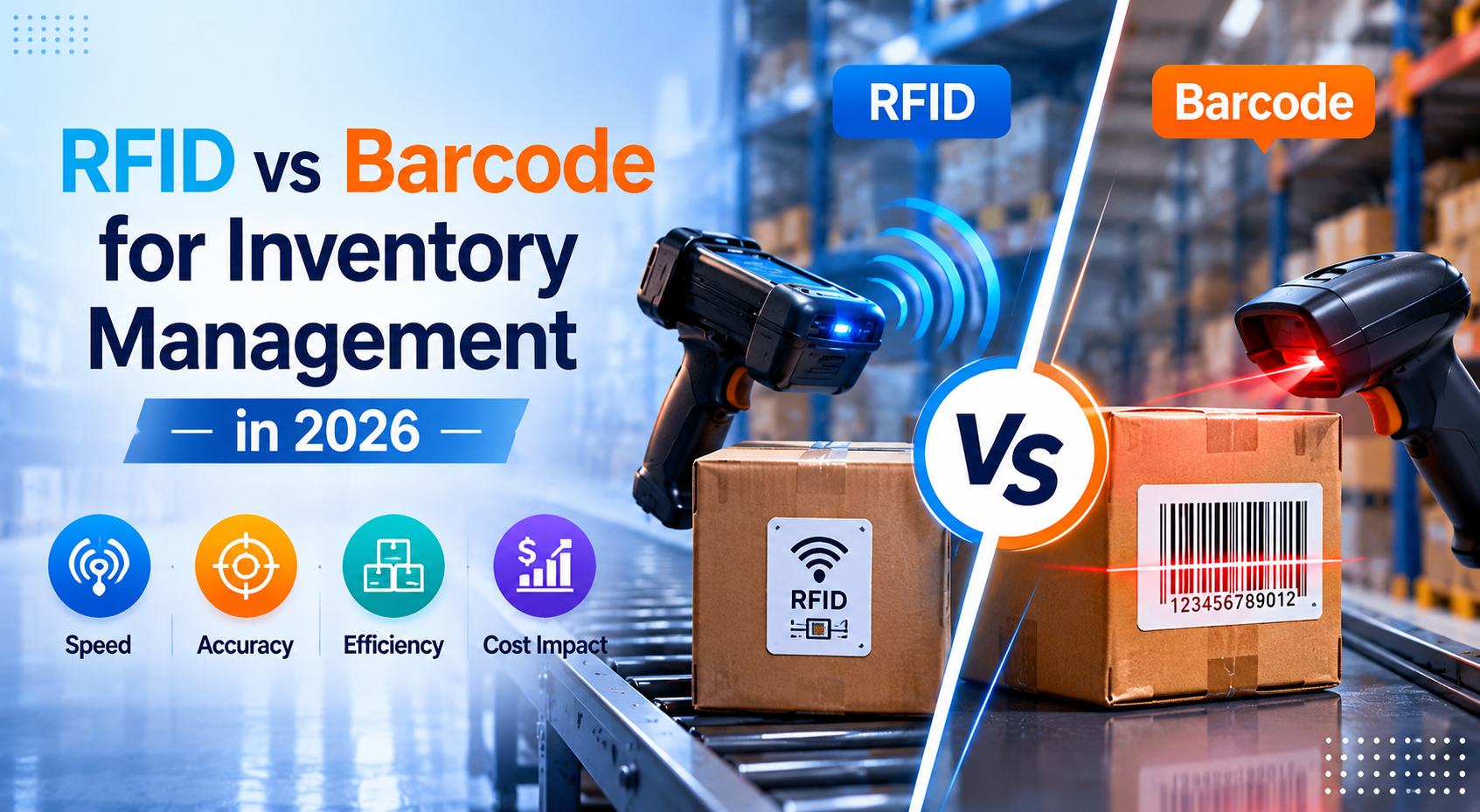
Choosing between RFID and barcode is one of the most consequential decisions a warehouse, retail operator, or hospital can make about inventory. Both technologies do the same job at the surface—identify an SKU—but their cost curves, scan speeds, accuracy, and operational implications differ by an order of magnitude. This guide breaks down where each one wins, what they actually cost in 2026, and how Indian operators should think about the choice for warehouses handling 10,000 to 10 million items per year.
TL;DR
| Factor | Barcode (1D / 2D) | Passive UHF RFID |
|---|---|---|
| Per-tag cost (high volume) | ₹0.05 – ₹0.50 | ₹4 – ₹15 |
| Line of sight needed | Yes | No |
| Read speed | 1 item at a time | 200 – 1,000+ items per second |
| Read range | A few cm to 1 m | 3 – 10 m typical |
| Typical inventory accuracy | 60 – 80% | 95 – 99% |
| Best for | Low-cost, high-value-density SKUs; structured scan workflows | Apparel, healthcare, asset tracking, mixed-pallet receiving |
In short: barcode is cheap and proven, RFID is fast and precise. Most enterprises in India still end up running both — and the right question is usually where to apply RFID, not whether to.
How each technology actually works
Barcode
A barcode is a printed pattern (1D stripes or 2D matrices like QR/Data Matrix) that encodes a number. An optical scanner shines light on it, reads the reflected pattern, and decodes the number. The cost is essentially the printing — fractions of a rupee per label — but every scan needs line of sight and a human or device to aim at one tag at a time.
GS1’s family of standards (UPC, EAN, GTIN) keeps barcode numbering consistent across the world, which is why the same scanner reads a soap pack made in Tamil Nadu and a phone made in Vietnam.
RFID
RFID (radio-frequency identification) tags contain a tiny antenna and chip. A reader transmits radio energy; the tag absorbs it, powers up, and replies with its unique EPC (Electronic Product Code). No light, no aiming, no line of sight.
There are two practical flavours:
- Passive UHF RFID (860–960 MHz in India under WPC rules): no battery, ~3–10 m range, the workhorse for inventory and supply chain.
- Active RFID: battery-powered, 30–100 m range, used for vehicles, containers, large assets.
For most inventory use cases, “RFID” in 2026 means passive UHF.
Cost: total cost of ownership, not just tag price
Sticker price isn’t the whole story. A fair RFID-vs-barcode total cost of ownership comparison includes:
- Consumables: tags or labels per unit
- Reading hardware: handheld scanners vs handheld RFID readers, plus fixed RFID portals/overhead readers
- Software: middleware to filter reads, integration into the WMS/ERP
- Labour: time per cycle count, per receiving cycle, per pick
- Error / shrink cost: stockouts and overstocks caused by inaccurate counts
A realistic Indian warehouse cycle count of 5,000 SKUs takes a 3-person team about a full shift with barcodes. The same job with a fixed RFID portal takes a single operator pushing a cart for an hour. When you cost that labour gap across 52 weeks of cycle counts, the per-tag premium evaporates quickly for medium- to high-value goods.
A rough rule used by procurement teams: if an item’s selling price is above ₹500 and stock accuracy materially affects revenue, RFID’s incremental tag cost is recovered in 6–18 months. Below that price point, barcode usually wins on cost per unit moved.
Speed and accuracy — the real differentiator
The single statistic that drives most RFID business cases is scan throughput. With barcode, one worker reads roughly 2,000 items per hour under good conditions. A fixed RFID portal reads the same 2,000 items in under 15 seconds as the carton passes through.
For inventory accuracy, the gap is similarly dramatic. Industry research and customer audits we’ve run with Indian apparel and electronics retailers consistently show:
- Barcode-only stores typically run at 65–80% SKU-level inventory accuracy
- RFID-enabled stores typically reach 95–99% accuracy
Why the gap? Barcode counting is sampling — humans get tired and skip cartons. RFID is a census — every tag in a zone replies.
When barcode is still the right answer
RFID is not a universal upgrade. Barcode remains the better choice when:
- Item value is very low (a sachet of detergent, a pencil) where a ₹5 tag is more than the item is worth
- You have liquids or metals at item level without specialised tags — both detune RFID antennas
- Workflow is human-intensive and structured — a single-station check-out counter scanning items one at a time gets no value from RFID’s parallelism
- Regulatory or customer mandates require a printed code (GS1 DataMatrix on pharma packs, FSSAI markings)
A practical pattern Indian 3PLs use: barcode at item level, RFID at case/pallet level. The ₹8 RFID tag on a pallet pays for itself the first time you receive that pallet without unpacking.
When RFID is the clear winner
- Apparel and footwear retail: 99%+ accuracy unlocks ship-from-store, omnichannel fulfilment, and meaningful shrink reduction. Decathlon, Zara, and Indian brands like Lifestyle and Trends have moved aggressively to RFID.
- Healthcare and pharma: tracking implants, surgical instruments, expensive consumables. Expiry and cold-chain compliance benefit from non-line-of-sight reads inside drawers and refrigerators.
- Manufacturing WIP: tagging trolleys or work-in-progress carts gives you live floor visibility without operator scans.
- Returns and reverse logistics: bulk-reading a return carton vs scanning each unit saves hours per shift.
- High-shrink categories: cosmetics, accessories, small electronics.
Implementation checklist for Indian operators
Before you commit to either path, walk through these questions in order:
- What is your target inventory accuracy and what is the revenue cost of being below it today?
- How many SKUs do you handle, and what is their average value?
- What is your receiving model — sealed cases from one vendor, or mixed cartons from many?
- Do you have WMS or ERP middleware that can ingest the data, or will reads die at the reader?
- Is your facility RFID-friendly (no continuous metal racking, no liquid SKUs at item level), or will you need site surveys and shielding?
- What are your frequency requirements — India’s WPC permits 865–867 MHz for unlicensed UHF RFID; ensure your readers and tags are tuned for this band, not the US 902–928 MHz allocation.
- Do you have an anti-counterfeit or warranty use case? RFID’s unique EPC per item gives you a chain-of-custody asset barcode can’t.
FAQ
Is RFID always better than barcode?
No. For very low-value, low-margin items moved in highly structured workflows, barcode is usually more economical and equally effective. RFID’s advantages — speed and non-line-of-sight reads — only translate into rupees when accuracy and labour are bottlenecks.
How much does an RFID tag cost in India in 2026?
Passive UHF inlay tags from established vendors typically run ₹4–₹15 each at volume, depending on chip generation, encoded memory, and form factor. Tags optimised for metal or liquids cost more.
Can RFID and barcode coexist?
Yes — and most large operators run them in parallel. A common pattern is barcode at item level for legacy compatibility, RFID at case or pallet level for fast receiving and cycle counting. A modern WMS handles both transparently.
Do I need a license to operate RFID in India?
Passive UHF RFID at 865–867 MHz is permitted under WPC (Wireless Planning & Coordination Wing) general guidelines without an individual license, subject to power limits. Always confirm with your integrator that hardware is tuned to the Indian band rather than ETSI or FCC defaults.
Can RFID read through metal or liquid?
Plain inlay tags struggle near metal and liquid because both detune the antenna. Specialised “on-metal” tags and foam-spaced labels solve this — at 2–5× the cost of standard inlays. Site survey first, decide tag form factor second.
Talk to Aeologic about a hybrid RFID + barcode rollout sized to your category and accuracy targets. We’ve deployed in apparel retail, pharma cold chain, and high-volume e-commerce fulfilment across India — get in touch for a site survey.
