

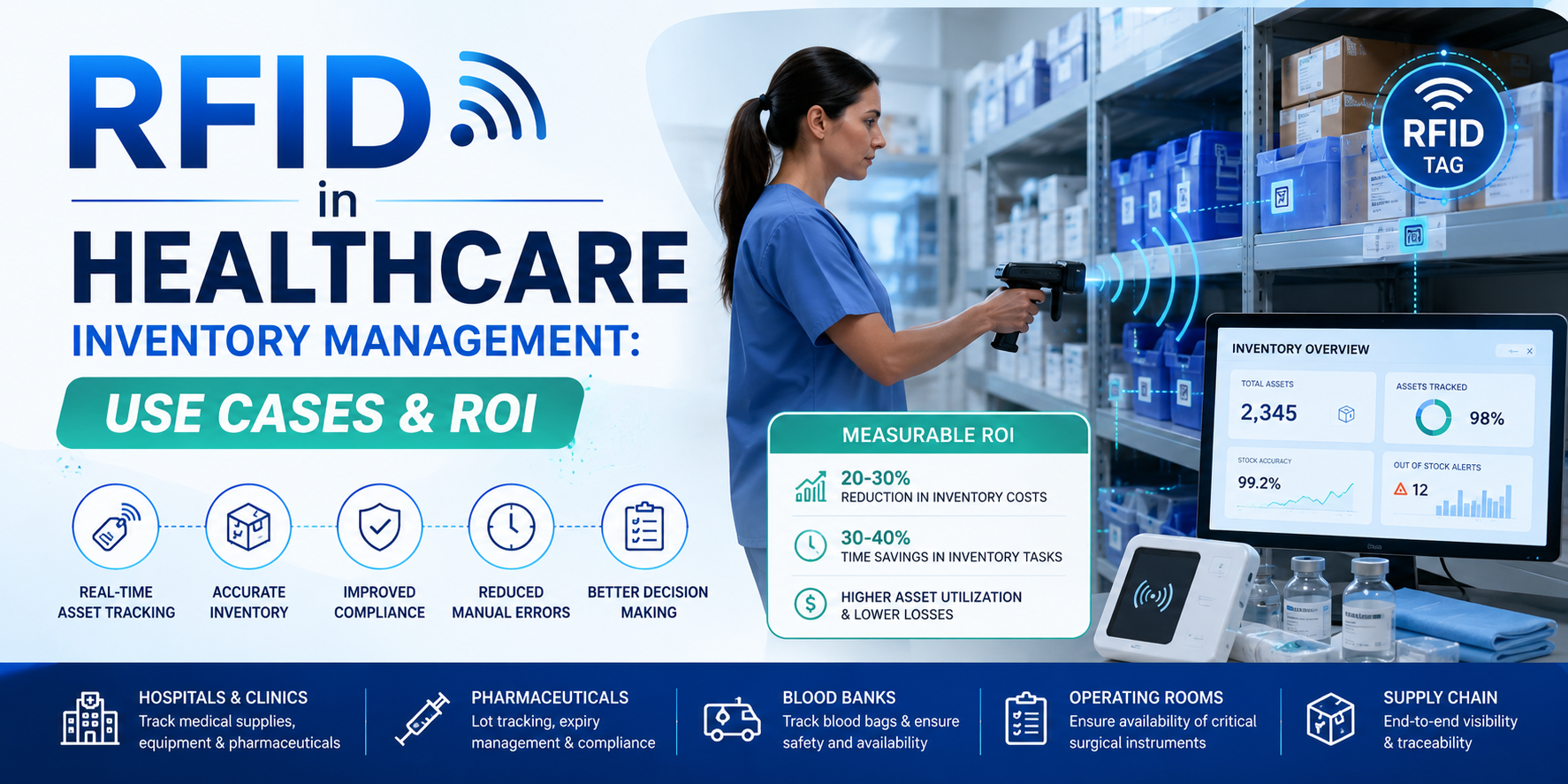
Healthcare is the single most asymmetric inventory environment: the cost of running out of a stent during surgery is incomparably higher than the cost of running out of a t-shirt size. That asymmetry is why RFID in healthcare has moved from pilot to mainstream in Indian tertiary-care hospitals — and why the ROI math, surprisingly, comes out favourable across a wide range of facility sizes. This guide walks through the practical use cases, the hard numbers we’ve seen in Indian deployments, and the playbook for rolling out RFID in a hospital.
Why healthcare inventory is uniquely hard
Three properties make hospital inventory categorically different from retail or manufacturing:
- Heterogeneous, high-value SKUs: a single hospital catalogue includes ₹50 saline bags and ₹3 lakh implants. ABC analysis applies, but the criticality overlay matters more than value.
- Expiry is non-negotiable: drugs and devices past expiry cannot be used. Cold-chain items have additional time-temperature constraints. Wastage from expiry is a major hidden cost.
- Regulatory chain-of-custody: under Schedule M and CDSCO frameworks, hospitals must be able to trace any drug or implant back to a specific batch and supplier — for years after the patient leaves.
These three properties make barcode-only systems fragile. Barcode workflows assume manual scans; healthcare workflows are unpredictable, interrupted, and frequently occur in sterile environments where touch is constrained.
High-impact RFID use cases in hospitals
1. Surgical instrument tracking
Operating theatres typically run with kit-based instrument sets — a tray of 30–80 instruments specific to a procedure. Counting these instruments before and after surgery, today done manually, has been a documented source of “retained foreign object” incidents.
RFID-tagged instruments (autoclave-rated tags) read in seconds at the prep station and again at the table.
Indian deployments we’ve seen at multi-specialty hospitals:
- 90%+ reduction in pre-op counting time
- Near-elimination of mis-kitted trays
- ₹15–25 lakh / year recovered from finding “lost” instruments that previously got written off
2. Implant traceability
Cardiology, orthopaedics, and neurosurgery use high-value implants — stents, hip components, intracranial coils — that must be traceable by serial number to the patient. CDSCO and ICMR guidelines require this lineage to be maintained for years.
RFID tags on implant packaging let the OR scan the implant into the patient record automatically at the point of use. Manual barcode workflows fail here because surgeons and nurses are gowned and sterile; RFID requires no touch.
Hospitals running RFID-driven implant logging report:
- 99%+ accuracy in linking implant lot to patient
- 80% reduction in administrative time per implant
- Audit-ready chain-of-custody for regulatory inspection
3. Pharmacy and cold-chain management
Hospital pharmacies stock thousands of SKUs with overlapping batches and expiries. RFID lets a single read of a shelf or refrigerator return the full inventory snapshot — including any item nearing expiry.
For cold-chain (vaccines, biologics, certain biotherapeutics) RFID combined with temperature sensors gives:
- Live shelf-life tracking accounting for actual temperature exposure
- Automatic expiry alerts at 30, 14, and 7 days
- Reduced wastage from expired stock — typically cutting wastage by 30–50%
4. Mobile asset tracking
Wheelchairs, IV pumps, defibrillators, beds — large hospitals struggle to find equipment when needed. Active RFID or BLE-RFID hybrid systems give floor-level location for these assets.
Deployments at Tier-1 hospitals report:
- 25–35% reduction in capital expenditure on mobile assets (less duplication because nothing is “lost”)
- 60%+ reduction in nurse time spent searching for equipment
5. Consumables management
A typical surgical case uses 30–60 consumable items — sutures, syringes, gauze, electrocautery pads. Tracking these manually for billing and reorder is error-prone. RFID-tagged consumables at the OR cart capture usage automatically.
Benefits:
- 5–8% improvement in case-based billing accuracy
- Auto-generated reorder triggers prevent stockouts
- Better visibility into consumption per procedure type
ROI: the math for an Indian hospital
For a 300-bed multi-specialty hospital, a typical RFID rollout looks like:
Investment (one-time)
- Fixed RFID readers and gates (15 zones): ₹35–50 lakh
- Handheld RFID readers: ₹6–10 lakh
- Software, middleware, WMS integration: ₹25–40 lakh
- Tags (initial inventory of ~50,000 items): ₹3–6 lakh
- Implementation services, training: ₹15–25 lakh
- Total: ₹85 lakh – 1.3 crore
Annual recurring
- Tags for new inventory: ₹3–5 lakh
- Software AMC, support: ₹8–12 lakh
- Total: ₹12–18 lakh / year
Annual benefits
- Reduced expiry wastage: ₹25–40 lakh
- Recovered lost/written-off instruments: ₹15–25 lakh
- Reduced theft/leakage of consumables: ₹10–20 lakh
- Audit and compliance efficiency: ₹5–10 lakh
- Avoided “never event” risk reduction: hard to quantify but material
- Total: ₹55 lakh – 1 crore / year
Payback in 12–24 months for most multi-specialty deployments. The number that surprises people is the wastage line — expiry losses in hospital pharmacies are typically much larger than CFOs realise until tracked properly.
How this differs from retail RFID
RFID in retail (see our RFID vs Barcode comparison) optimises speed and accuracy of large item counts. RFID in healthcare optimises traceability and safety of small but critical item counts.
Operational implications:
- Tag form factors are different: autoclave-rated, biocompatible, on-metal-friendly
- Privacy considerations apply: patient-linked data must be protected per Digital Personal Data Protection (DPDP) Act 2023
- Workflow integration is deeper: RFID reads have to land in the hospital EMR, not just a WMS
- Adoption is clinician-driven: nurses and surgeons must accept the system or it gets bypassed
A realistic rollout playbook
Phase 1: scope (4–6 weeks)
- Define which workflows get RFID: OR, pharmacy, central sterile, biomedical assets
- Conduct an RFID site survey for each zone — metal racks and water pipes can detune readers
- Lock down integration points to EMR, HIS, ERP
Phase 2: pilot (8–12 weeks)
- Pick one OR and one pharmacy as pilot zones
- Tag a defined inventory subset
- Run dual-mode (manual + RFID) for 4 weeks to validate accuracy
- Measure baseline KPIs (count time, wastage, accuracy) before and after
Phase 3: rollout (3–6 months)
- Extend to all OR rooms, all pharmacy locations, all biomedical assets
- Integrate auto-reorder with the hospital ERP
- Train all clinicians and pharmacy staff
- Set up exception dashboards and weekly review cadence
Phase 4: optimise (ongoing)
- Quarterly review of tag survival rates, reader uptime
- Annual re-survey of zones as facility layout evolves
- Continuous tightening of expiry alert thresholds and consumption analytics
The single biggest predictor of success: a clinical champion — a senior surgeon or pharmacist who actively endorses the system in the first 90 days post-deployment.
Common pitfalls
Under-tagging
The temptation to tag “only the high-value items” creates blind spots. Better to tag broadly within scope (e.g., all OR instruments, not just expensive ones) so the workflow is consistent.
Treating RFID as a bolt-on
If RFID reads don’t flow into the EMR/HIS, you’re just creating a parallel inventory database. The integration work is where the value lives.
Over-engineering the pilot
A 6-month pilot with 14 KPIs almost always stalls. Pick 3 KPIs (count time, accuracy, wastage) and a 60-day timebox.
Ignoring biomedical concerns
Some hospitals hesitate because of perceived interference with medical devices. UHF RFID at 865–867 MHz, properly deployed, is non-interfering with FDA/CE-class medical devices — but the assurance has to come from your integrator with documentation.
FAQ
Is RFID safe to use in hospitals?
Yes — UHF RFID at the Indian-permitted 865–867 MHz band has been validated for use in clinical environments worldwide. Integrators must provide non-interference documentation for biomedical equipment classes used at your facility.
What’s the typical ROI period for hospital RFID?
12–24 months for a multi-specialty hospital, driven primarily by reduced expiry wastage, recovered lost instruments, and reduced consumable leakage.
Can RFID tags survive autoclave sterilisation?
Yes — autoclave-rated tags (ceramic or specialised polymer encapsulation) survive 1,000+ cycles at 134°C. They cost 5–10× more than standard inlays but are essential for OR instruments.
Does RFID interfere with patient privacy?
It can if implemented carelessly. Properly designed systems separate item-level RFID reads from patient identifiers, link them only in the encrypted EMR, and comply with the Digital Personal Data Protection (DPDP) Act 2023.
What’s the smallest hospital that benefits from RFID?
In our experience, hospitals above 100 beds with active OR and pharmacy operations show positive ROI. Below that, the implementation cost is harder to amortise — though specific sub-modules (e.g., pharmacy expiry alone) can still make sense.
Considering RFID for your hospital? Aeologic deploys hospital-grade RFID across OR, pharmacy, central sterile, and biomedical assets, with full HIS/EMR integration and DPDP-compliant data handling. Schedule a site survey.
