

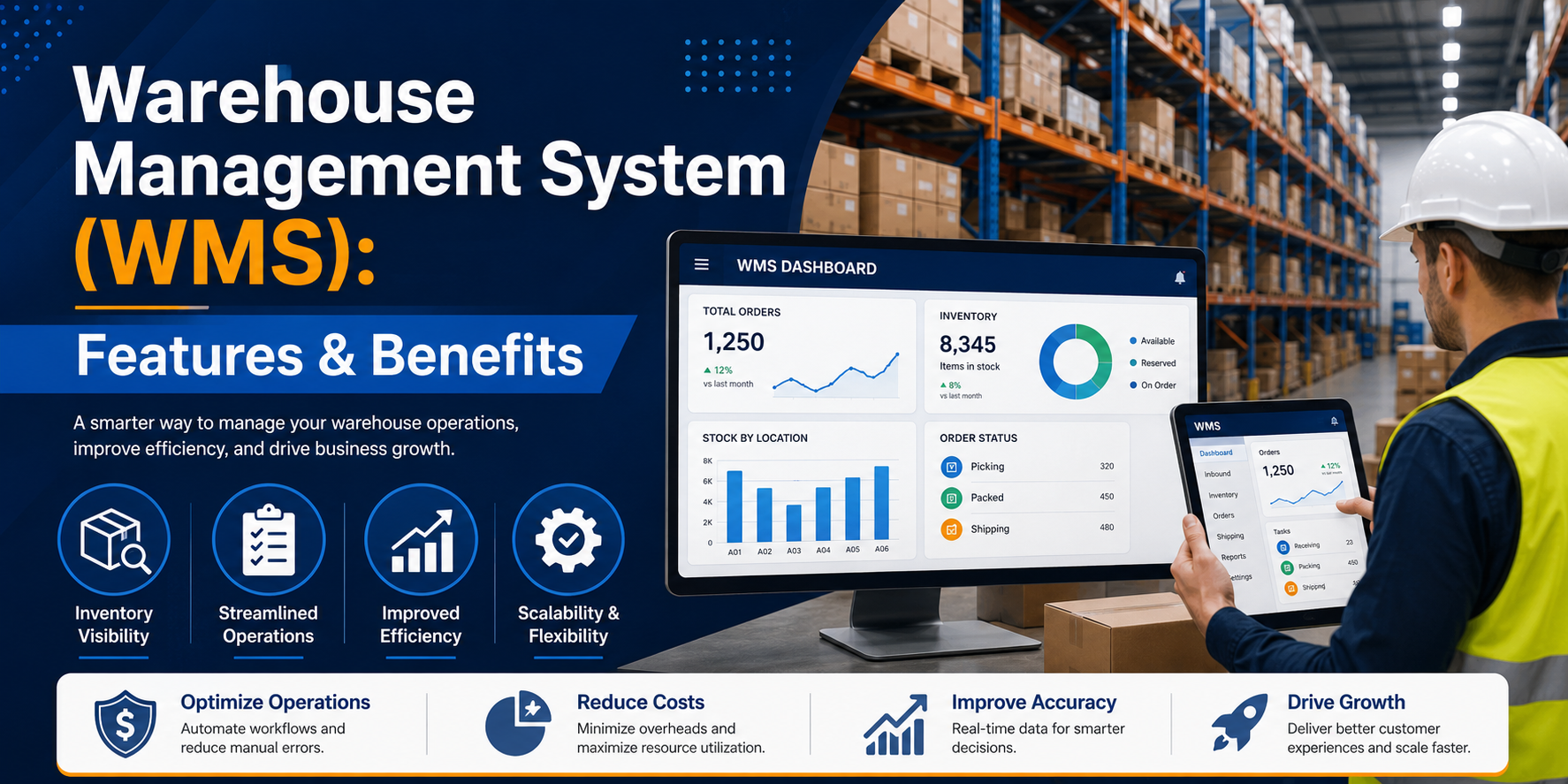
A warehouse management system (WMS) is the operating system of a modern warehouse. It controls what comes in, where it goes, how it’s picked, and how it leaves. Done well, a WMS lifts throughput by 20–40%, cuts stockouts to under 2%, and gives finance and the customer the same answer about what’s in stock. Done badly, it’s an expensive way to recreate spreadsheets. This guide explains what a WMS actually does, the modules to look for, where it sits relative to your ERP, and how to scope a credible deployment for an Indian warehouse.
Core definition
A WMS is software that manages the physical movement of inventory within a warehouse. It tracks each unit (or case, or pallet) by location, directs operators on what to do next, captures every event, and feeds the resulting data into upstream systems (ERP, e-commerce, finance).
The distinction worth keeping in mind:
- Inventory management answers “how much of SKU X do I have?”
- WMS answers “where exactly is each unit of SKU X, and what should we do with it next?”
Many ERPs do the first job acceptably. Almost none do the second well.
What a modern WMS does, by phase
Inbound: receiving and put-away
- Match incoming pallets to expected POs and ASNs (advance shipping notices)
- Scan items at the dock for SKU and quantity verification
- Compute the optimal storage location (the put-away algorithm) based on velocity class, weight, temperature, and SKU affinity
- Direct the put-away operator turn-by-turn to that location
- Confirm storage with a scan, updating the live slot map
A good put-away algorithm alone can cut walk-time in the warehouse by 20–30%.
Storage: slotting and replenishment
- Maintain a slot map linking SKUs to physical locations (zone → aisle → bay → level → bin)
- Recompute slotting periodically based on velocity — fast-moving items belong near the dispatch dock
- Trigger forward-pick replenishment when bin levels drop below threshold
- Manage multiple units of measure (each, case, pallet) per SKU
Outbound: picking, packing, shipping
- Receive orders from the order management system or marketplace
- Allocate stock to orders (FIFO, FEFO for perishables, batch-specific for pharma)
- Generate optimised pick paths — single-order, batch-pick, zone-pick, wave-pick — based on order profile
- Direct pickers via handheld, voice, light, or pick-to-cart
- Sort, pack, weigh, label, and stage for dispatch
- Generate shipping labels and EWB (e-way bills) for Indian compliance
Returns: reverse logistics
- Process inbound returns against a returns RMA
- Inspect, grade, and route to put-back, repair, refurbishment, scrap, or donation
- Restore good stock to the slot map and update available-to-sell figures
Cross-functional: continuous tracking
- Cycle counting module with task management and discrepancy resolution
- Yard management for trucks waiting outside
- Labour management with task-level productivity metrics
- Reporting and analytics with the nine inventory KPIs and more
WMS vs ERP — where each fits
A common Indian buyer question: “We have SAP — why do we need a WMS?” Useful framing:
| Capability | ERP | WMS |
|---|---|---|
| Total inventory by SKU | ✓ | ✓ |
| Locations within a warehouse | ✗ (or weak) | ✓ |
| Operator task direction | ✗ | ✓ |
| Pick-path optimisation | ✗ | ✓ |
| Cycle count workflows | Basic | Full |
| Procurement, GL, AR/AP | ✓ | ✗ |
| Master data ownership | Usually | Subordinate |
| Real-time floor visibility | ✗ | ✓ |
The right mental model: ERP is the financial system of record. WMS is the operational system of record. They integrate and exchange data — purchase orders flow from ERP to WMS at receiving; goods receipts and dispatch confirmations flow from WMS back to ERP for accounting.
If your warehouse moves more than ~1,000 lines per day, or you operate across multiple zones, or you need to support omnichannel and ship-from-store, ERP-only is going to constrain you.
Types of WMS deployment
On-premise WMS
Installed in your own infrastructure. Examples: Manhattan WM, SAP EWM, Oracle WMS. Best for large enterprises with heavy customisation needs and strict data residency requirements.
Cloud / SaaS WMS
Hosted by the vendor, accessed over the web. Examples: Manhattan Active WM, Blue Yonder Luminate, Oracle WMS Cloud, and a growing set of Indian SaaS WMS vendors. Best for fast deployment, predictable cost, and easier scaling.
ERP-bundled WMS
A WMS module inside the ERP itself (e.g., Microsoft Dynamics 365 Warehouse Management, SAP S/4HANA Stock Room Management). Sensible when the warehouse needs are modest and ERP fit is more important than best-of-breed.
Best-of-breed standalone WMS
A specialist WMS integrated with the existing ERP. Almost always wins on warehouse functionality; loses on number of integration points to maintain.
For most Indian mid-market deployments today, cloud / SaaS WMS wins on cost-of-ownership and time-to-value.
Benefits — what you should actually expect
After a successful WMS deployment, credible improvements:
- Inventory accuracy: 95% → 99%+
- Pick productivity: +20–40%
- Order fill rate: +3–8 percentage points
- Stockouts: -50% or better
- Labour cost per order: -15–25%
- Cycle count time: -60–80% with the right scanning workflow
These aren’t promises — they’re medians across deployments. Your real number depends on starting state, vertical, and how aggressively you change processes alongside the software.
Scoping a WMS deployment for an Indian warehouse
Six questions to answer before evaluating vendors:
- Order profile — how many orders/day, how many lines/order, how many SKUs per pick path? This drives picking strategy more than anything else.
- SKU profile — total SKUs, units of measure, special handling (cold chain, hazmat, fragile, batch-tracked)?
- Inbound profile — pallets per day, mixed vs single-SKU cartons, ASN-availability from suppliers?
- Compliance — pharma (CDSCO, Schedule M), food (FSSAI), GST (e-way bill thresholds), export documentation?
- Integration surface — ERPs, marketplaces, 3PL APIs, carrier APIs, e-way bill portal?
- Hardware reality — barcode-only, RFID, voice picking, conveyor sortation, robotics?
Scoping these honestly produces an RFP that vendors can respond to meaningfully. Skipping them is how mid-sized Indian operators end up with a WMS that doesn’t fit their volume.
Common implementation mistakes
Trying to lift-and-shift existing process
A WMS deployment is a process reset, not a code-for-code migration of how the warehouse runs today. The biggest wins come from changing slot strategy, pick paths, and exception handling — not just running the old process faster.
Underinvesting in master data
If your SKU master has duplicates, missing dimensions, and wrong unit-of-measure conversions, every WMS feature downstream will limp. Budget 15–25% of total project effort on master data cleanup.
Going live without dual-running
A 30–60 day dual-run period — old system and new running in parallel — catches edge cases that no UAT script does. Skipping this is the most common cause of post-go-live chaos.
Treating training as an event
Operator productivity in the first 4 weeks after go-live is the most important predictor of project ROI. Plan for daily refreshers, floor-walking trainers, and explicit metrics on adoption — not a single training session and a hope.
FAQ
What is a warehouse management system (WMS)?
A WMS is software that manages and optimises the physical movement of inventory inside a warehouse — receiving, put-away, storage, picking, packing, shipping, and returns — and feeds that data to upstream systems like ERP and e-commerce.
Is a WMS the same as inventory management software?
No. Inventory management software typically tracks how much of each SKU exists across the company. A WMS tracks exactly where each unit is within a warehouse and directs the operators handling it.
Do I need a WMS if I have SAP / Oracle / Tally?
If the warehouse has more than ~1,000 daily lines, multiple zones, or needs real-time omnichannel visibility, yes — even alongside a strong ERP. Below that threshold, an ERP-bundled WMS or inventory module often suffices.
How long does WMS implementation take?
Cloud WMS for a single warehouse: typically 8–14 weeks. On-premise enterprise WMS for a large network: 6–18 months. Master data quality is the biggest variable.
What does a WMS cost in India?
Cloud / SaaS WMS for a mid-sized warehouse: roughly ₹3–10 lakh / year all-in (licenses + integration + support). Enterprise on-premise: ₹50 lakh to several crore one-time plus annual maintenance.
Considering a WMS rollout? Aeologic specialises in cloud WMS deployments for Indian retailers, distributors, and 3PLs, including hardware (barcode/RFID), integrations, and operator training. Request a scoping call.
